
Let’s answer the headline question honestly before anything else. Yes, a bathroom singer can make money singing online. No, it is not automatic, and anyone who tells it to you has already lost your trust before the pitch even starts.
This guide skips the hype and gets into what actually happens when someone with zero performing experience decides to enter a real online singing competition. How prizes actually work, what eligibility usually requires, how voting decides outcomes, and what a first-timer should genuinely expect before recording a single note.
Setting Expectations Before You Even Hit Record
The internet is full of promises that sound too clean to be true, mostly because they are. “Guaranteed payout.” “Everyone wins something.” “Sign up and start earning today.” None of that describes how a legitimate singing competition actually works, and it is worth being suspicious of anything that does promise it.
What actually happens looks more like this. You enter a specific contest. That contest has its own theme, timeline, and reward pool, published before you commit to anything. Fans listen to every entry during a voting period and choose the performances they genuinely want to support. Whoever ends up on top of that particular leaderboard earns whatever that contest’s terms specify. Nothing about this is fixed or guaranteed in advance, because it depends entirely on how the voting plays out.
That may sound less exciting than a guaranteed payday, but it is the version that is actually real, and real is worth more than a promise that evaporates the moment you read the fine print. If you have been searching for a way to make money singing online that does not involve a hidden fee somewhere in the process, this qualifies, provided you understand the outcome is earned through votes rather than handed out automatically.
How Prizes Actually Work?
Every contest on a platform like Mic2Money publishes its reward pool before entries open, so you are never guessing what a specific competition is offering. Rewards are typically tied to points and tier progression, meaning consistent participation and strong results build toward something bigger over time rather than resetting after a single entry.
A few honest truths about prizes worth knowing upfront:
- Rewards vary by contest. What one competition offers has nothing to do with what another one does.
- Eligibility matters. Some rewards, particularly payouts, may be limited by region, so check the specific terms for where you live before assuming anything.
- Points and rewards are not the same as a salary. This is a competition structure, not employment, and treating it otherwise sets you up for disappointment.
- Results are verified, not adjusted quietly, which means a strong showing on the leaderboard actually reflects real votes.
So How Much Could You Actually Earn?
This is the question every bathroom singer actually wants answered, and the honest response is that nobody can hand you a fixed number before you have entered anything, because the outcome genuinely depends on the contest. What can be said with confidence is how the mechanics work.
An artist who wants to earn money singing competition by competition is essentially stacking small, contest-specific outcomes over time. One entry might land a modest reward tied to a smaller contest’s pool. Another might place higher in a bigger competition with more fan participation and a larger pool attached to it. Points earned along the way can also push you up a tier, which can unlock access to bigger contests down the line. None of it is a fixed hourly wage, and none of it should be marketed as one.
What tends to separate artists who genuinely earn money singing competition after competition from those who try once and walk away is simple persistence combined with paying attention to what worked. A song choice that landed well, a genre tag that pulled the right listeners, a share that brought in an unexpected batch of votes- all of that is information you carry into the next entry.
How Eligibility Actually Works?
Most contests keep entry requirements simple by design, since the entire model depends on making it easy for independent artists and solo artists alike to get in the door.
Common eligibility basics typically include:
- Creating a free account and building a short artist profile.
- Meeting any age or regional requirements listed for that specific contest.
- Submitting original or properly rights-cleared material, since retaining ownership of your own music matters here.
- Following the submission window and format guidelines for the contest you entered.
None of this requires industry connections, formal training, or expensive equipment. It requires reading the specific contest’s rules and following them, which most first-timers skip in their excitement and later regret.
How Does Voting Actually Decide Who Earns Something?
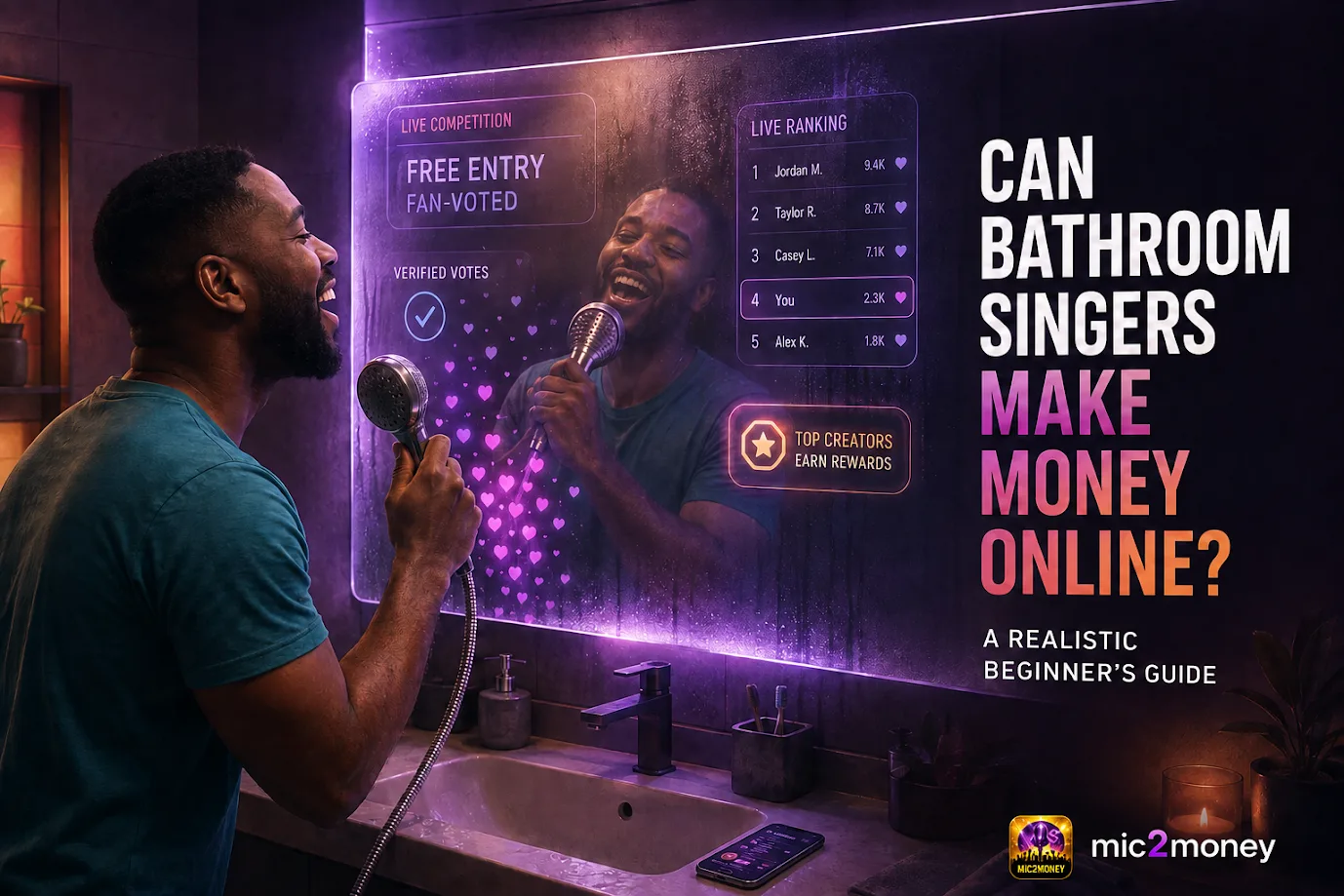
This is the part that separates a fair singing contest from a rigged one, so it deserves a straight answer. Voting works through real fans listening to submissions and casting votes for the performances they genuinely enjoy. A trustworthy platform ties every vote to a verified account, which rules out bots and duplicate voting schemes that quietly favor whoever has the most fake accounts rather than the most real support.
Leaderboards update live throughout the voting period, so a bathroom singer with a modest following can watch their ranking shift in real time as genuine listeners discover and support their entry. Nobody can buy their way to the top. Fans cannot purchase a ranking boost for an artist they like, and artists cannot pay for extra votes. The only thing that actually moves a contest’s outcome is real listener support, verified and tracked transparently.
The technical backbone that keeps this fair, the vote verification, the live leaderboard, and the app itself, is handled by Cobweb Games and Appsters, the teams responsible for building and maintaining the platform end to end.
A Realistic Timeline: What Happens After You Hit Submit?
Understanding the actual sequence helps set expectations correctly. Here is roughly what unfolds after a bathroom singer decides to give an online singing competition a real shot.
- You submit your entry before the contest deadline, and it becomes visible to fans browsing that competition.
- The voting period opens, and fans listen to your track alongside every other entry in that contest.
- Your ranking becomes visible on a live leaderboard that updates as votes come in.
- You share your entry link, which is usually the single biggest lever a beginner has, since existing friends and family voting early can meaningfully shift early momentum.
- Voting closes, results are verified, and outcomes are finalized according to that contest’s published terms.
- You either earn a reward tied to your placement, or you gather feedback and enter the next contest with a stronger entry.
Neither outcome should be treated as the end of the story. A single contest is one data point, not a verdict on your voice.
Why “Realistic” Does Not Mean “Not Worth Trying”
It would be easy to read all of this cautious language, the qualifiers, the “depends on eligibility,” the refusal to promise a number, and conclude that entering is not worth the effort. That would be the wrong takeaway.
Free entry means the actual cost of trying is close to zero. A single recording session and a bit of promotion is a tiny investment compared to what traditional talent shows or paid platforms demand. Even a modest result gives a first-time bathroom singer something they did not have before: real listener feedback, a small pocket of fans, and a much clearer answer to whether their voice actually lands with strangers.
Realistic does not mean discouraging. It means going in with your eyes open, which is exactly the position that leads to smarter decisions about which contests to enter and how to prepare for them.
Compare this honestly against the other ways people try to make money singing online. Paid vocal courses often cost real money upfront with no guarantee they lead anywhere. Studio session work usually requires connections most beginners simply do not have yet. Posting covers on social media can build an audience eventually, but it rarely comes with a structured, published reward pool attached to a specific event. A free singing contest with transparent terms sits in a different category entirely: low cost, low risk, and a clear structure for how outcomes get decided.
It also helps to remember that a single contest result, good or modest, is not a permanent verdict. A bathroom singer who enters five contests over a few months and treats each one as a lesson will almost always end up in a stronger position than someone chasing a single viral moment. Consistency tends to beat luck in this format, mostly because the leaderboard rewards genuine listener support built over time rather than a one-off spike in attention.
Comparing Notes: What Separates a Strong Entry From a Forgettable One?
Not every entry performs the same, even within the exact same contest, and understanding why helps anyone trying to make money singing online avoid the most common first-timer mistakes.
Entries that tend to underperform usually share a few traits. The song choice stretches the singer’s range past what they can comfortably deliver. The recording has heavy background noise or an obvious echo. The genre tag does not match the actual sound, which sends the entry to listeners who were never going to connect with it in the first place. And often, the artist submits once, gets a modest result, and never returns to apply what they learned.
Entries that tend to perform well share the opposite pattern. A comfortable song choice that fits the voice naturally. A clean, quiet recording space- even a closet works better than an untreated room. An honest genre tag that puts the entry in front of the right listeners. And a willingness to share the entry with people who already know the artist, since those first few votes often create the early momentum that pulls in additional listeners through the discovery feed.
None of this is complicated, but it does require treating a music competition as something worth a bit of preparation rather than a spontaneous, zero-effort upload. A bathroom singer who spends twenty extra minutes picking the right song and recording space is already ahead of a large share of the entries in any given contest.
Your Bathroom Career Just Got a Real Stage
Every shower has an acoustic sweet spot, and every bathroom singer already knows exactly where theirs is. What happens next is entirely up to whether you are willing to trade four tiles and a shower curtain for a live leaderboard and a few strangers willing to actually press vote. Making money singing online starts the moment you decide the bathroom was just practice.
1. Can a total beginner actually compete in an online singing competition?
Yes. Most fan-voted platforms are built for a wide range of skill levels, not just trained vocalists. What matters most is an honest, listenable performance rather than technical perfection.
2. Do I need a professional microphone to enter?
No. A phone recording in a quiet space is usually enough to enter. Judgement comes from fans listening to the performance itself, not the equipment behind it.
3. Is there any cost to enter a singing contest as a beginner?
On legitimate platforms, no. Entry is free, and any reward pool for a specific contest is published before you submit, so you know what a competition is offering upfront.
4. How does voting work if I am new and have no existing fans?
Contests typically surface new entries through the platform’s discovery feed, not just an artist’s existing following, so first-timers can still be found and voted on by fresh listeners.
5. What can I realistically expect from my first singing competition entry?
Treat it as a starting point rather than a guaranteed outcome. Rewards depend on the specific contest’s terms and how voting unfolds, but even a modest result gives you real feedback and a small early audience to build from.
