
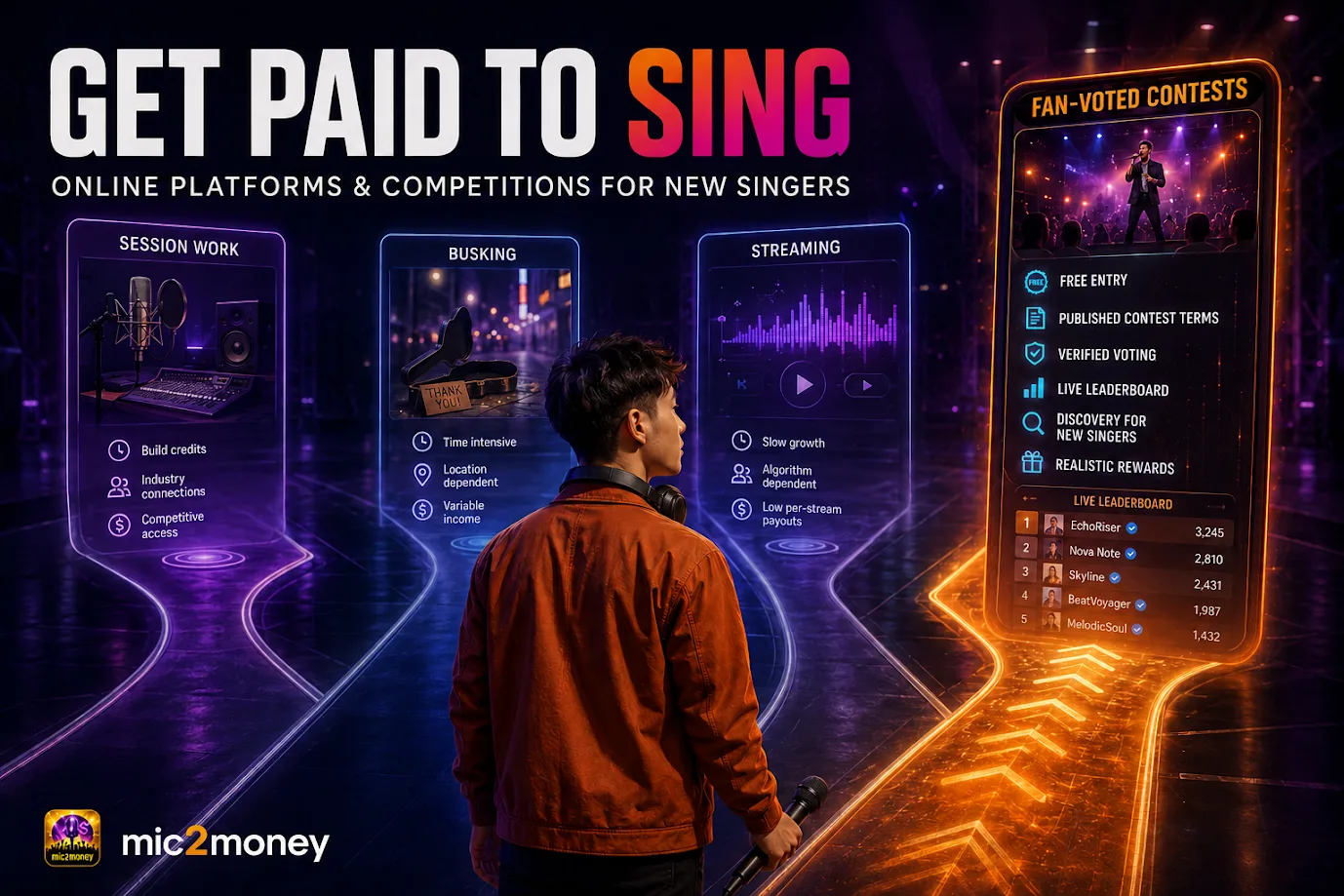
Type get paid to sing into any search engine, and you will get a flood of results, some legitimate, most either recycled advice or thinly disguised traps. New singers deserve a straight comparison, not another listicle padded with the same five obvious tips. This one actually breaks down the real categories of platforms out there, how they differ, and where a fair, fan-voted singing contest fits into that picture.
The Landscape: What Getting Paid to Sing Actually Includes
Before comparing platforms, it helps to separate the categories, since they get lumped together constantly and they are not remotely the same thing.
Session and cover work, one of the more traditional music contests adjacent routes. Paid gigs singing covers or backing vocals for other creators. This usually requires an existing network or a talent agency relationship, which most new singers do not have yet.
Busking and live tips. Real, but location-dependent and inconsistent, and it does not translate to an online audience at all.
Streaming royalties. Technically a way to get paid to sing, but the payout per stream is small enough that it only becomes meaningful after building a substantial catalog and audience, which takes years for most independent artists’ careers.
Online singing competition apps. Free-to-enter, fan-voted platforms where performances are judged by real listeners rather than industry gatekeepers, with rewards tied to specific contest outcomes.
New singers searching for a genuine starting point usually find that the fourth category offers the lowest barrier to entry by a wide margin, which is exactly why it deserves a closer look.
What to Compare Before Choosing a Platform?
Not every music competition app is built the same way, and the differences matter more than most beginners realize. Four things are worth checking before entering anything.
Entry rules. A trustworthy singing competition app never charges an entry fee. If a platform asks for payment before you have even submitted a track, that is an immediate red flag, not a minor inconvenience to work around.
Prize structure. Reward pools should be published and visible before you commit to a contest, not revealed after you have already submitted. Vague promises of big prizes with no actual terms attached are a warning sign, not a selling point.
Voting system. This is where most platforms differ the most. Some rely on judge panels that mirror traditional talent shows, which reintroduces the gatekeeping problem new singers are trying to avoid. Others use fan voting, where real listeners decide outcomes. Fan voting only works if it is actually verified, meaning votes are tied to real accounts and cannot be purchased.
Accessibility. Some platforms are built around influencers who already have large followings, quietly favoring anyone who arrives with an existing audience. Others are designed so new entries get surfaced through a discovery feed, giving a completely unknown singer a genuine shot at being heard.
Where Mic2Money Fits Into the Comparison?
Mic2Money is a free-to-enter, fan-voted music competition app built specifically around the gaps most new singers run into elsewhere. Entry costs nothing. Contest terms and reward pools are published before you submit a track. Voting is tied to verified accounts, so nobody can buy their way onto the leaderboard, and new entries surface through the platform’s discovery feed rather than depending entirely on an existing following.
The technical backbone behind that structure- the live leaderboard, the verification layer, the app itself- was engineered through a partnership between Cobweb Games and Appsters, two studios that specialize in exactly this kind of build. Cobweb Games brought the production discipline usually reserved for competitive games, the ranking systems, the live scoring, the mechanics that make a contest actually feel like a contest rather than a static form. Appsters engineered the mobile infrastructure and account verification that keeps every result honest. That division of labor is part of why the platform holds up the way it does, rather than feeling like a rushed side project bolted onto an existing app template.
None of this changes the basic honesty required around outcomes. Rewards depend on the specific contest you enter, your eligibility, and how voting plays out, so no legitimate platform should be promising you a guaranteed number before you have submitted anything.
Comparing Prizes and Voting Side by Side
A useful way to think about any online music competition is to ask three questions before entering.
Who actually decides the outcome, a small judge panel or a broad base of real fans? Fan voting tends to reward performances that genuinely connect with listeners rather than performances engineered to please a handful of insiders.
Is the reward pool visible before you commit, or does the platform stay vague until after you have already submitted a track?
Transparency here says a great deal about how seriously a platform takes its own credibility.
Can a brand new singer with zero followers actually get discovered, or does the platform quietly favor accounts that arrive with an audience already built? This single factor separates competitions that are genuinely open from ones that only look open on the surface.
Running any singing competition app through those three questions before entering will filter out most of the platforms not worth a new singer’s time.
What a Realistic First Contest Looks Like?
A new singer entering their first fan-voted contest should expect a process, not an instant payday. You build a short profile, submit a track recorded on whatever equipment you already own, and share the entry with people who already know your voice to get early momentum. From there, the platform’s discovery feed does the rest of the work, surfacing your entry to fresh listeners throughout the voting window.
By the time the contest closes, you have real data, a leaderboard position, a handful of new listeners, and a clear read on whether your song choice and delivery actually landed. Some contests will result in a reward tied to that specific competition’s terms. Others will simply hand you information you can use to enter the next one stronger. Both outcomes move you forward.
How Do Earnings Actually Compare Across These Routes?
Anyone trying to earn money singing online eventually has to weigh these routes against each other honestly, since trying to earn money singing online by chasing all four routes at once rarely works out faster than picking one and committing to it. Session work pays per gig but requires a network most new singers spend years building. Streaming royalties pay per stream, which sounds appealing until you calculate what that actually means without an existing catalog and fan base. Busking pays in cash on the spot but depends entirely on foot traffic and location, with zero online reach attached to it.
Fan-voted music contests sit in a different category from all three. There is no requirement to already have a network, a catalog, or a physical location. The entire structure is built around a single, contained event: enter, get heard, get voted on, see where you land. That structure is exactly why so many new singers researching how to get paid to sing eventually land on this option before the other three, since it asks the least in exchange for a real, measurable shot.
What Makes a Platform Worth Calling the Best Online Singing Competition Platform?
Not every song artist competition app deserves that kind of praise, and it is worth being specific about what actually earns it. A platform worth your time as a new singer typically checks every box on this list.
It functions as a genuinely free music competition app, with no entry fee hidden behind a signup flow. It runs as an online music competition with contest terms and reward pools published before you commit anything. It operates a fan voting app for musicians layer that is verifiable, meaning votes tie back to real accounts rather than bots or duplicate signups. And it treats music artist competition entries from total beginners with the same visibility as it gives to artists who have entered a dozen times before.
Mic2Money was built to meet all four of those standards at once, which is precisely why it functions as a credible answer for new singers comparing options rather than just another song artist competition app free download with nothing behind it.
A Realistic Walkthrough for a New Singer Comparing Options
Picture someone who has spent a weekend researching how to get paid to sing and has narrowed the search down to a handful of apps. The smart move at this point is not signing up for all of them at once. It is running each option through the same short checklist: is entry free, is the reward pool published, is voting verified, and does a brand new account actually get surfaced to real listeners?
Most apps fail at least one of those four checks. Some hide entry fees behind a premium tier disguised as an upgrade. Others publish vague prize language that never resolves into an actual number. A few have voting systems with no real verification at all, which quietly turns the leaderboard into a popularity contest for whoever has the most bots. Filtering out on just those four questions usually leaves a new singer with one or two legitimate options worth actually trying.
From there, the decision becomes simple. Pick the platform that treats a first-time entrant fairly, submit a track that represents your actual voice, and let the contest’s own mechanics, fan voting, live leaderboards, and discovery feeds do the rest of the work that used to require an agent or a lucky break.
Why This Matters More For New Singers Than Anyone Else?
Established artists with existing followings can survive a mediocre platform, since their audience will find them regardless of how the app is built. New singers do not have that luxury. The platform itself has to do real work to get a new singer heard, which is exactly why comparing singing competition apps on real criteria, not marketing copy, matters more for someone just starting out than for anyone already established.
That is also why a platform worth using as a genuine route to get paid to sing has to be judged on structure, not promises. Structure is what determines whether a new singer with zero followers actually gets a fair shot, or quietly gets buried under accounts that already had an audience before they ever opened the app.
The Honest Bottom Line for Anyone Weighing These Routes
None of the four categories covered here are wrong choices exactly. Session work, streaming royalties, and busking all have their place for the right artist in the right circumstances. What sets a fan-voted music contest apart is accessibility. It does not require a network you have not built yet, a catalog you have not recorded yet, or a location you cannot always get to. It requires a recording and a willingness to enter, which is a far lower bar than the other three routes typically demand from someone just starting out.
That accessibility is exactly why so many new singers researching how to get paid to sing keep circling back to this option once they have actually compared it against the alternatives side by side.
Choosing Where to Actually Spend Your Time
New singers rarely have unlimited time to test every platform that claims to help them get paid to sing. The smartest approach is picking one legitimate, free-to-enter singing contest, learning how its voting and reward structure actually works, and building a habit of entering consistently rather than spreading thin energy across a dozen half-tested apps.
Your Voice Just Got a Fair Shot
Every new singer eventually runs into the same wall, wanting to be heard without needing a connection to get there. A fair, fan-voted online singing competition removes that wall entirely, leaving only the performance itself standing between you and a real audience. For anyone still comparing platforms and wondering exactly how to get paid to sing without waiting years for a lucky break, that removed wall is the entire point.
Frequently Asked Questions
1. Is it actually possible to get paid to sing without industry connections?
Yes, through fan-voted singing competition apps that do not require an audition panel or existing network. Rewards depend on the specific contest’s terms and your eligibility rather than who you know.
2. What separates a legitimate singing competition app from a scam?
Free entry, published reward pools before submission, verified fan voting, and a discovery system that gives new entries real visibility are the key markers of a trustworthy platform.
3. Do fan-voted competitions actually favor unknown singers?
Platforms built with a genuine discovery feed do, since new entries get surfaced to fresh listeners rather than relying only on an artist’s existing following.
4. How does voting actually determine who gets paid?
Real listeners vote for performances during a contest’s voting window, and rankings update live. Verified voting systems prevent purchased votes or fake accounts from influencing results.
5. Should I enter more than one singing competition app to increase my chances?
It is usually more effective to focus on one legitimate, transparent platform and enter consistently, since building a track record and small audience on a single platform tends to compound results over time.
